
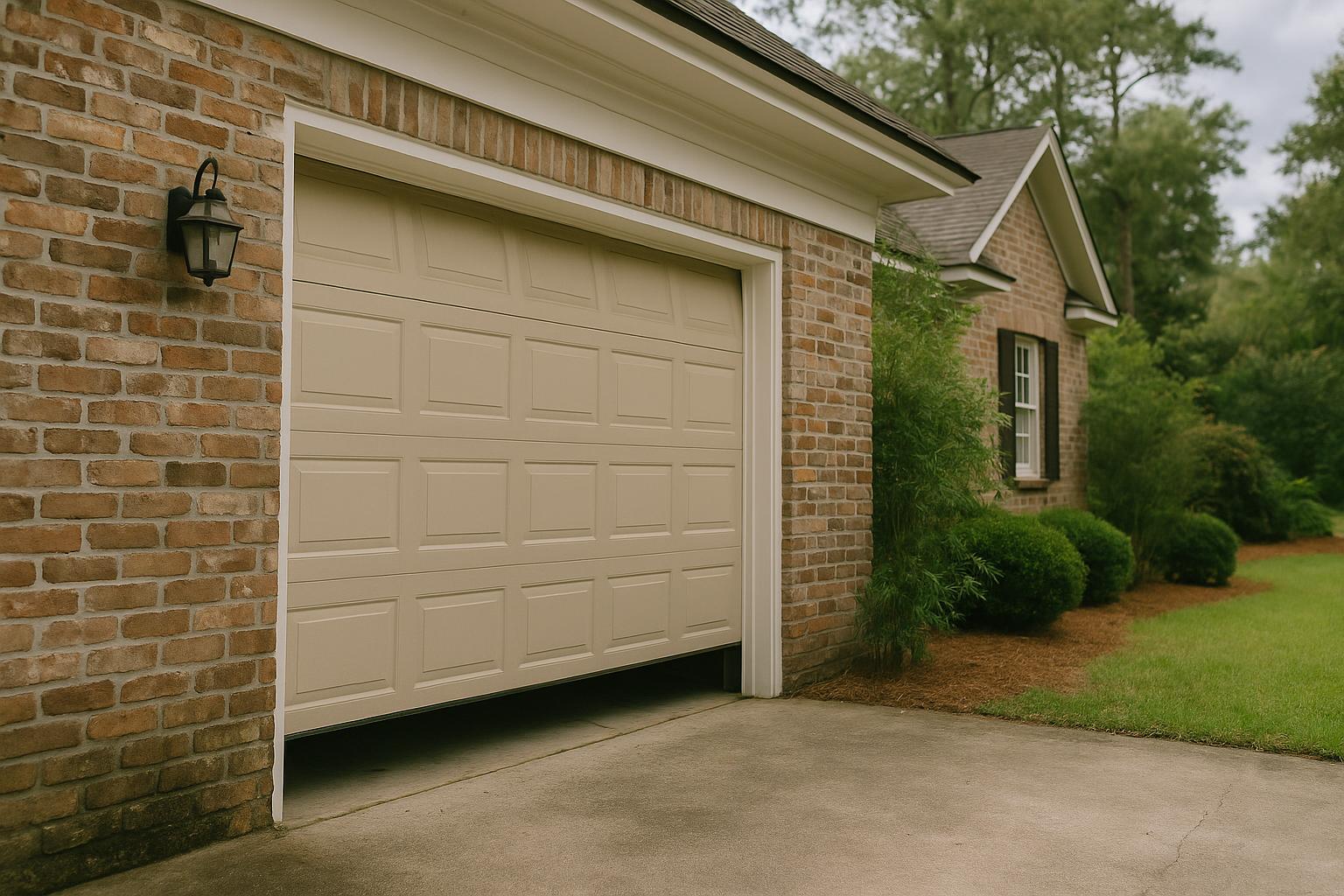
That Frustrating Moment When Your Garage Door Won't Stay Closed
You press the button on your remote, watch the garage door glide downward, and then — just inches from the floor — it stops, reverses, and goes right back up. You try again. Same thing. Maybe you try holding the wall button, and it still won't cooperate.
This is one of the most common garage door complaints we hear from homeowners across Savannah, and it's more than just an annoyance. A garage door that won't fully close leaves your home vulnerable to weather, pests, and security risks. The good news is that this problem almost always has a clear, fixable cause.
Let's walk through the most likely reasons your garage door reverses before reaching the floor and what you can do about each one.
1. Misaligned or Dirty Safety Sensors
This is the number one cause of a garage door that reverses before closing, and it's often the easiest to fix yourself.
Every garage door opener manufactured after 1993 is required to have photoelectric safety sensors — two small devices mounted near the bottom of the door tracks on either side. They send an invisible beam across the opening. If anything breaks that beam while the door is closing, the opener reverses the door to prevent it from crushing a person, pet, or object.
Here's the thing: these sensors are sensitive. They can be triggered by:
- Misalignment — If one sensor gets bumped even slightly, the beam won't connect and the door will reverse every time.
- Dirt or cobwebs — Savannah's humidity and active insect life mean sensor lenses get dirty fast. A thin layer of grime can block the beam.
- Direct sunlight — Bright afternoon sun hitting a sensor can interfere with the infrared signal, which is why some homeowners notice the problem only at certain times of day.
What to try: Wipe both sensor lenses with a soft cloth. Check that both sensors have a steady green light (a blinking light usually means misalignment). Gently adjust the sensors until both lights are solid. If the wiring looks frayed or the sensors are damaged, it's time to call a professional.
2. The Close-Limit Switch Needs Adjusting
Your garage door opener has a setting called the close-limit switch (sometimes called the down-limit or travel-limit). This tells the opener exactly how far the door should travel before it considers itself "closed."
If this setting is off — even by a small margin — the opener may think the door has hit an obstruction when it actually hasn't. The opener's built-in safety feature then kicks in and reverses the door.
This commonly happens after a new opener installation, a spring replacement, or even seasonal temperature changes that cause metal tracks and hardware to expand or contract slightly. In a climate like Savannah's, where summer heat and winter cool create noticeable swings, this isn't unusual.
What to try: Most openers have limit adjustment screws on the back or side of the motor unit. Small adjustments — usually a quarter turn at a time — can solve the problem. Check your opener's manual for specific instructions. If you're not comfortable making these adjustments, a technician can dial it in quickly during a routine service call.
3. Worn or Broken Garage Door Springs
Your garage door springs do the heavy lifting — literally. They counterbalance the weight of the door so the opener doesn't have to work as hard. When springs wear out or break, the door becomes significantly heavier for the opener to manage.
Modern openers have a force-sensing feature. If the door requires more force to close than the opener expects, it interprets that as an obstruction and reverses. A weakened spring can create exactly this scenario.
Signs that springs may be the issue include:
- The door feels noticeably heavy when you lift it manually
- The door closes partway and then reverses
- You hear unusual grinding or straining sounds from the opener
- The door is visibly uneven when partially open
Important safety note: Garage door springs are under extreme tension and can cause serious injury if handled incorrectly. Spring replacement is not a DIY job. If you suspect a spring issue, please call a trained technician. At Savannah Garage Door, spring replacement is one of our most frequently performed services, and we keep common spring sizes on our trucks so most repairs can be completed in a single visit.
4. Something Is Physically Blocking the Door
Before diving into mechanical troubleshooting, take a careful look at the door's path. Sometimes the answer is simpler than you'd expect:
- A small object sitting in the track or along the floor seal
- Debris buildup in the bottom of the track channels
- A warped or bent track section causing the rollers to bind
- Weather stripping that has shifted and is catching on the frame
Savannah homeowners often deal with leaves, pine straw, and dirt accumulating around garage door tracks, especially during fall and after storms. A quick inspection and cleanup can sometimes solve the problem immediately.
5. The Opener's Force Settings Are Too Low
In addition to the travel-limit settings, most openers also have force settings that control how much push or pull the motor applies. If the closing force is set too low, the opener may not have enough power to fully close the door, interpret the resistance as an obstacle, and reverse.
This can happen if someone adjusted the settings previously, or if the door's balance has changed over time due to spring fatigue or hardware wear.
What to try: Like the limit switches, force adjustments are usually made with small screws on the opener unit. Increase the down-force setting in small increments and test after each adjustment. Be cautious — setting the force too high can override the safety reverse feature, which creates a genuine hazard.
When to Call a Professional
If you've cleaned the sensors, checked for obstructions, and the door still won't close properly, it's time to bring in an expert. Issues involving springs, cables, track alignment, or opener motor problems are best handled by someone with the right tools and training.
Here in Savannah and the surrounding communities like Pooler, Richmond Hill, and Rincon, we see these issues year-round. Heat, humidity, salt air, and seasonal storms all take a toll on garage door systems. Regular maintenance — including sensor checks, spring inspections, lubrication, and opener testing — can prevent most of these problems before they start.
Don't Let a Reversing Door Become a Bigger Problem
A garage door that won't close isn't just inconvenient. It compromises your home's security, energy efficiency, and protection from Savannah's unpredictable weather. Most reversing issues can be resolved quickly and affordably when caught early.
If your garage door is giving you trouble, Savannah Garage Door is here to help. Whether it's a simple sensor adjustment or a full spring replacement, we'll diagnose the problem and get your door working reliably again. Give us a call or reach out through our website to schedule a service appointment.